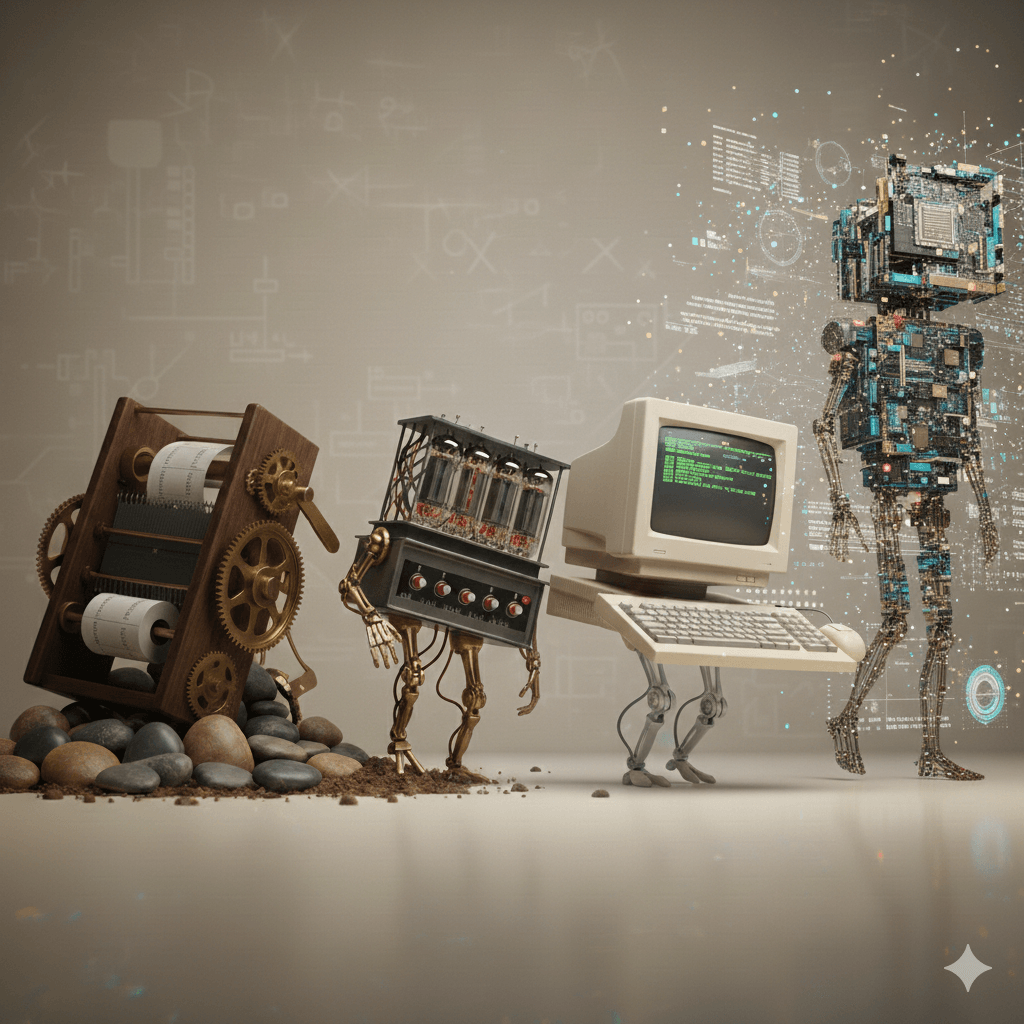
Software Engineering Is Dead, Long Live Software Engineering
My first programming language was Logo, a language designed for teaching wherein you direct a turtle around the screen, optionally having it draw to the screen. It was magical. My exposure was prior to my exposure to the math necessary to calculate the angles, so I brute-forced my way to a close-enough approximation on the weakly pixeled CRT monitor to draw cube wireframes, trying to give depth to a 2D world. Again, it was magical. The code? No. Again, I just hacked on that until the numbers worked for the pixels I had. The magic was in the computer doing something because I told it to, something of my design.
Fast forward to December 2025. I told some of my closest friends I was done coding by hand. They didn’t believe me.
In the years since Logo, I’d learned the math, and I’d learned to code. More, I learned to love code. And oh, can I be particular about my code. I’m reasonably certain I could look at 10-year-old code in a language I don’t really use anymore and tell you whether I wrote it or not… particular. Completely aside from the syntax, I’m an incredibly one-dimensional person. I eat, sleep, and breathe software. If I’m not creating it, I’m listening to a podcast about it. If I’m not listening to a podcast about it, I’m probably thinking about the next thing I’m going to try or what programming language would be best to do X or… maybe I should just write my own language. Sorry. I’ve probably made my point. My friends had good reason to not believe me.
Today? It’s FEB 2026 as I type this, and I mostly don’t write code anymore. Sure, I’ll change a line here or there, but I’m more likely to just prompt any corrections. I could gush about which tools I love and use and which I have and left, and maybe I will in another post, but I can tell you, I’m no longer gushing about a traditional IDE. Software engineering is dead.
Not too long ago, I said, “It was never about the code…” Let’s go back to where it started, at least where it started for me. Maybe you have a similar story. I’m 100%, without a doubt, certain my Logo code was absolutely heinous. I’m also certain it was magical. Now, I’m not comparing my bad code to AI slop. (AI slop is another topic I should address in a post.) I’m saying the code didn’t matter. It was the magic. My terrible code made amazing things happen, pixels moved, magic was created.
Now, I did enjoy writing code. I received a stupid amount of joy trying to be the very best developer I could be. I exulted in esoterica. I could tell you how the ordering of fields in a Go struct impacts memory usage (you should order fields largest to smallest). Or I could tell you the differences between Java’s StringBuffer, StringBuilder, and StringWriter. Wanna chat about the actor model in Python? I gotcha. (Check out Pykka, my current favorite.) The BEAM is magical. So on and so on, ad nauseam.
I like to say, “predicting the future is a fool’s game; here’s my crystal ball.” I think the era of humans writing code is coming to a close. Sure, there will be a long tail. I mean, we still have people writing COBOL to hold up significant portions of ridiculously important, complex systems. So, there will be people writing code for a good while yet, but the numbers will begin to shrink. The amount of code produced will go up, however. But, here’s the thing… It was never about the code. The hobbyist wants to get the computer to do a thing, make the magic. The business wants to build a product, serve customer needs. No one cares about the code. If you do care about the code, cool, but your users probably don’t. If you’re the only user, cool, feel free to carry on; I’m not talking to you.
If that depresses you, I’m sorry, truly. But, I do think there’s hope. Writing code won’t be a human activity, but software engineering will live on. It will change, the skills required to be the “best” will change, but it will live on. Mathematicians didn’t stop doing math because of calculators. Accountants didn’t stop keeping books because of software. Software has been disrupting industries from its inception. It’s our turn. It’s natural to be concerned or worried. I get it. I’m not going to sit here and tell you I know what things are going to look like. I don’t. But, try to look on the bright side. Imagine what we can accomplish as a species if these current developments result in the best possible outcomes. As an example, consider Karpathy’s reference to Starfleet Academy. (Yes, please!)
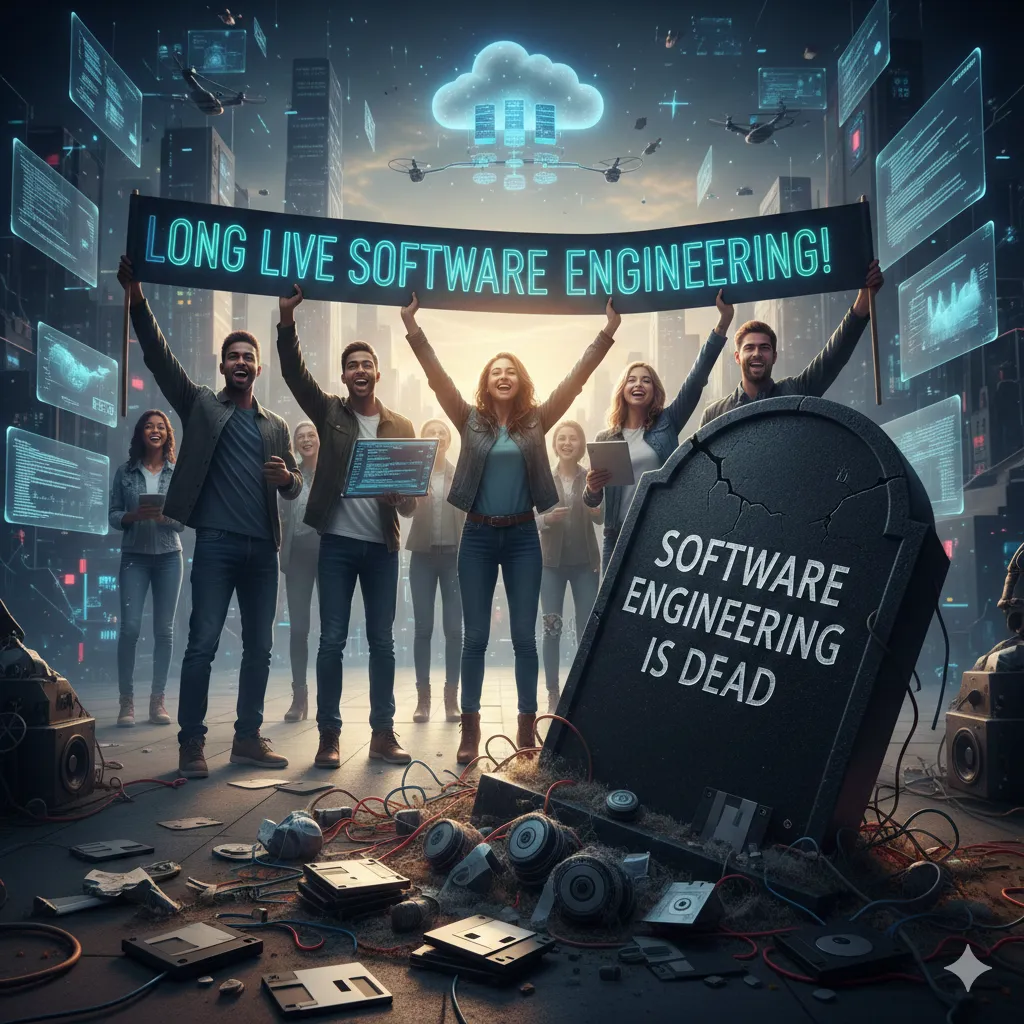
Software engineering is dead; long live software engineering!
In future posts, I may explore some of my guesses as to what comes next. Here’s a teaser: I think traditional IDEs are not it. Maybe how we answer the AI slop questions will also be a part…